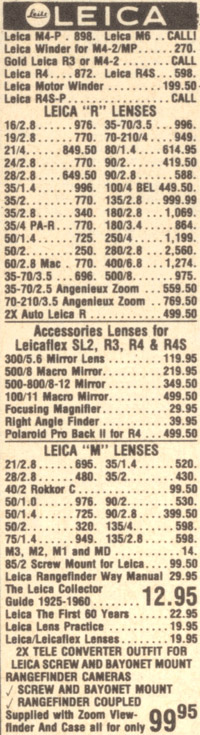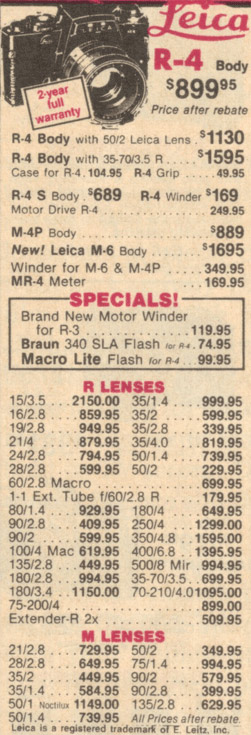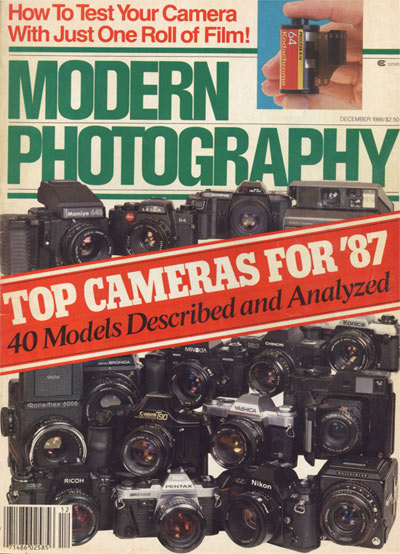
I came across an old issue of Modern Photography from December of 1986. Here are some Leica prices from 25 years ago:
- 50mm f/1.4: $725
- 50mm f/1 Noctilux: $1149
- Leica M6 body: $1695 (today on eBay, a Leica M6 in a good shape costs pretty much the same)
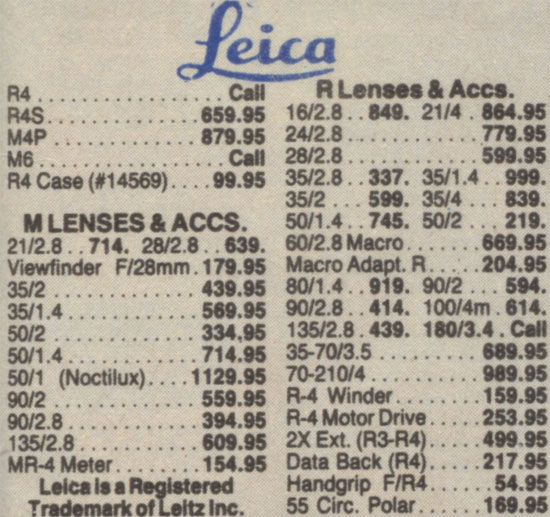
More Leica listings from 1986:
Related posts:


21 Comments
$1129 :O
Wow 50mm noct for $1200
I bought my Noctilux for around $1k a few years earlier. Times were lean back then too, and it seemed astronomically priced to me. I sold mine because it was too difficult to focus accurately, wide open.
Ahhh, Modern Photography. It was a great magazine. Too bad it went belly up just a short while later.
This is really funny; I came across the Modern Photography Top Cameras for ’84 about a week ago. It’s really interesting to see what cameras have become enduring classics (Canon A1, etc.) and which brands and cameras have completely been forgotten about.
I was a devoted Modern Photography reader / subscriber for many years, and I remember keeping those end of the year issues as a reference for the latest gear … Thankfully today we have Google!
Anyhow, around that time I was in college and my gear consisted of the M6 + 35mm/f2 (both are still in my collection) and a very old 50mm. Boy, those were the days when I was constantly confronting those brandishing their huge SLRs. Once a fella came up with his new Minolta Maxxum that featured something new on those days: Autofocus! He was teasing me how my camera was a relic with manual this and that, while his everything-auto-electronicy camera was the way of the future.
I wonder what happened to him … Or his camera >:->
I don’t know what happened to him, but his camera became the prototype for 99.9% of cameras sold and used in the world.
Good observation, but it also should be remembered that Minolta wasn’t the first to introduce the concept of AF to photography (think of the Nikon F3AF). Also, and in an ironic manner, AF led to the eventual demise of Minolta. The company was successfully sued by Honeywell for infringing on their patents for autofocus. The financial reparations Minolta was faced with eventually led to the merger with Konica in 2003, and ultimately to give up the photographic business in 2006.
And what about Leica? Interesting fact that Minolta had a fruitful alliance with the German company, just think of the numerous Leica Rs and CL/E. But most importantly consider this little bit of information:
“In the 1970s, the [Leica] company invented the auto-focus lens but sold the patent to Japanese rival Minolta, reasoning that its customers knew how to focus.”
Source: The Wall Street Journal;
http://online.wsj.com/article/SB122152103387739231.html#ixzz1J9e3ZcRh
Actually: Pentax was first to develop a camera with AF – it used contrast detection AF. Minolta though first developed the Phase Detection AF system and introduced AF DSLR camera to mass consumer.
“ultimately to give up the photographic business in 2006″ – they didn’t gave up. After few years of cooperation with Sony company bought KM photography business and used Minolta Japan naming convention to create Sony Alpha system which first two cameras (A100 and A700) were Minolta designs that didn’t managed to get into production on Konica own strength.
Great comment.
Inflation between 1986 and now is about 100%, which means doubling of the prices. Leica stuff has unfortunately increased much more than the rest…
Hey, that’s an R4 on the cover!
I love my R4-Mot…..!!! http://www.sigmauserforum.com/forum/images/smilies/z04_cowboy.gif
thats how leica is too overpriced!
Use this handy tool to see how much Leica is overcharging today:
http://www.westegg.com/inflation/
2011 price of 50mm 1.4: $3,695
1986 Price of 50mm 1.4 (adjusted for inflation): $1,422
What accounts for the $2,273 dollar raise in price? Luxury Douchery?
>2011 price of 50mm 1.4: $3,695
>1986 Price of 50mm 1.4 (adjusted for inflation): $1,422
>What accounts for the $2,273 dollar raise in price? Luxury Douchery?
>
you do realize that they are two completely different lenses? that the current 50/1.4 is a radical redesign of the fast 50 lens, one near-universally acclaimed as the best performing lens of its kind ever? that it uses exotic glass and aspherical elements?
one might better ask, what accounts for your facetious question? …
obviously, we would all love it if leica prices were lower. but, let’s not pretend they don’t offer unique and useful products.
ohmygosh! “Exotic glass!” “Aspherical elements!” All things found in, among many other expensive components, pro lenses and zoom lenses from Nikon. And you can get their 35mm 1.4 for $1,800. Leica’s is FIVE THOUSAND DOLLARS!
I don’t care how good a 50mm it is, it’s not $4K good. And no way it costs much more to produce the current 50, than the old one. Unless the “radical redesign” includes making the thing out of solid gold.
I think the Velban theory is the best answer to my question.
My facetious question is because Leica annoys me by pricing their goods out of the hands of working photographers and artists, just to satisfy their Luxury market of wealthy enthusiasts.
Also Leica only makes a couple unique products, the M9 and maybe the Noctilux. Zeiss and and to a lesser degree Voigtlander make world class lenses for those who wish to work with rangefinders, and price them so they can actually be used by people with real stories to tell.
some basic economic theory could help you out, if you really want an answer:
http://en.wikipedia.org/wiki/Veblen_good
cheers,
lucian.
here’s another theory that could explain it:
http://en.wikipedia.org/wiki/Veblen_good
although they’re just theories …. I think people pay lots for Leica products because they value them. They wouldn’t buy otherwise. (And in this I include myself).
best wishes.
$334 for a 50mm cron…
$700 for inflation.
msrp today $2k…
wow
Hmmm – let me see, time value of money

M6 in 1985 was 1700 bucks. Had you put that money into a savings account and reinvested the proceeds you would have gotten about 4 to 5 % per annum, compound, will give you about 5000 bucks in today’s money. Add a bit fir the fact you are not paying for film development and so on … And we are about there
Al