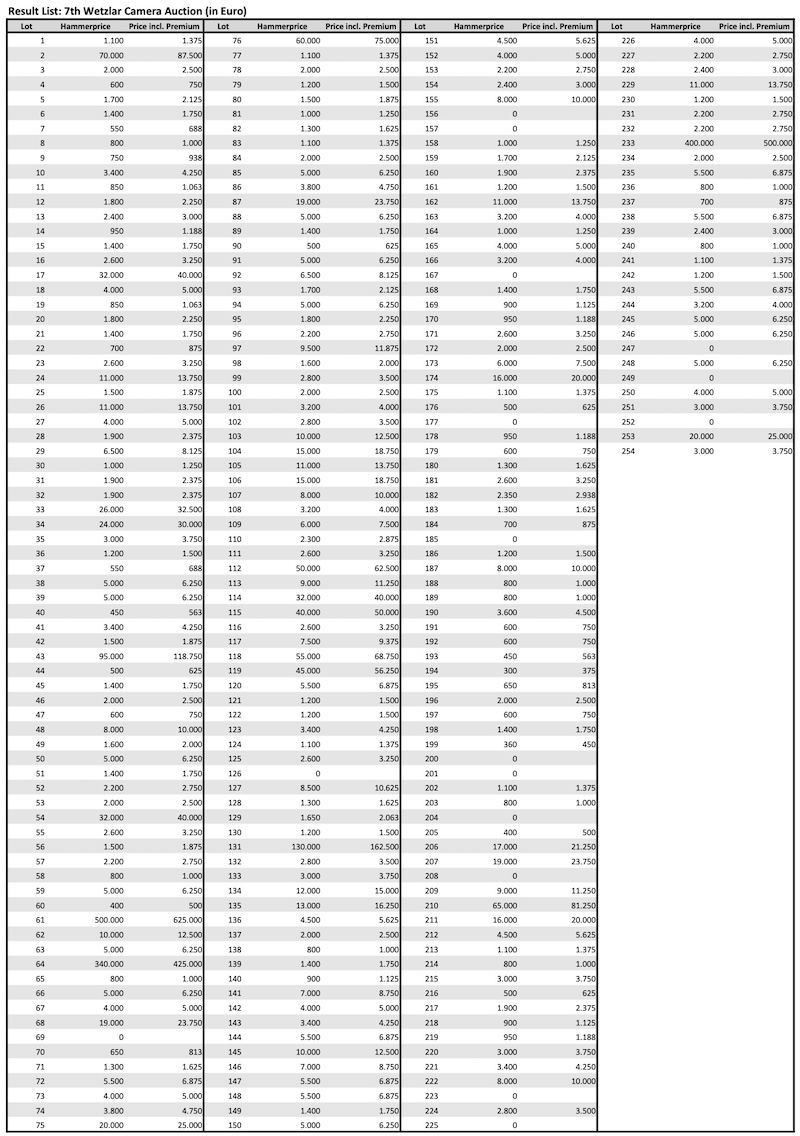
The results for the latest Wetzlar Camera Auctions 7 are now available online:
The next Wetzlar Camera Auctions #7 will take place on October 11 in Wetzlar
Metal camera from 1840 sold for EUR 500,000!
Wetzlar (wca). A total of 254 lots were auctioned off last Saturday at the seventh auction of Wetzlar Camera Auctions (WCA) for historic cameras and accessories. Most of them were Leica cameras.
Right at the start of the auction, lot number 2 achieved an exceptional result. A Leica Model A with Anastigmat lens from 1925 was sold for €87,500 after a starting price of €40,000. This hundred-year-old Leica camera was produced before the Leica was launched at the Leipzig Spring Fair in 1925. Only the very first 150 Leica series production models were equipped with Anastigmat lenses before the lens designation was changed to ‘Elmax’ (later ‘Elmar’), most of which were converted or upgraded in later years.
‘We estimate that fewer than 25 examples of the Anastigmat Leica still exist today in their original delivery condition,’ emphasised WCA co-owner Lars Netopil (Wetzlar).
The camera came from a German private collection and was in extremely beautiful and original condition.
Once again, astonishing results were achieved for particularly rare pieces.
A Leica Model 250 ‘Reporter’ from 1934 was sold for €40,000, after a starting price of €14,000. The Leica ‘Reporter’ was the only Leica camera model equipped with cassettes for 10 metres of film. This allowed 250 shots to be taken without changing the film. The auctioned model came from the pilot production run of only 20 units.
Other unusually high results were achieved with rare military versions of Leica M cameras: a black chrome-plated Leica M4, manufactured for the German Armed Forces in 1974, sold for €75,000 after a starting price of €18,000.
A real highlight in this year’s WCA catalogue was the Voigtländer metal camera from 1840. Following the invention of the photographic process by Louis Jaques Daguerre in Paris in 1839, the Voigtländer metal camera represents an important milestone in the history of photography technology. It was the first type of a metal camera ever made and was also equipped with the world’s first scientifically calculated lens. This lens, calculated by Prof. Josef Maximilian Petzval, already had a maximum aperture of f/3.7 at the time. Today, only about 12 to 15 examples of the Voigtländer metal camera manufactured in Vienna are known to exist worldwide, most of which can be admired in museums. The auction offered an extremely rare opportunity to acquire such a piece, and interest from bidders worldwide was correspondingly strong. Several interested parties were connected to the auction room by telephone and engaged in an impressive bidding battle until the very end.
WCA co-owner Jo Geier (Vienna): ‘It was exciting for us to have such an important camera from the early history of photography on offer. We are delighted that this piece achieved a sale price of €500,000, double the estimated price.’
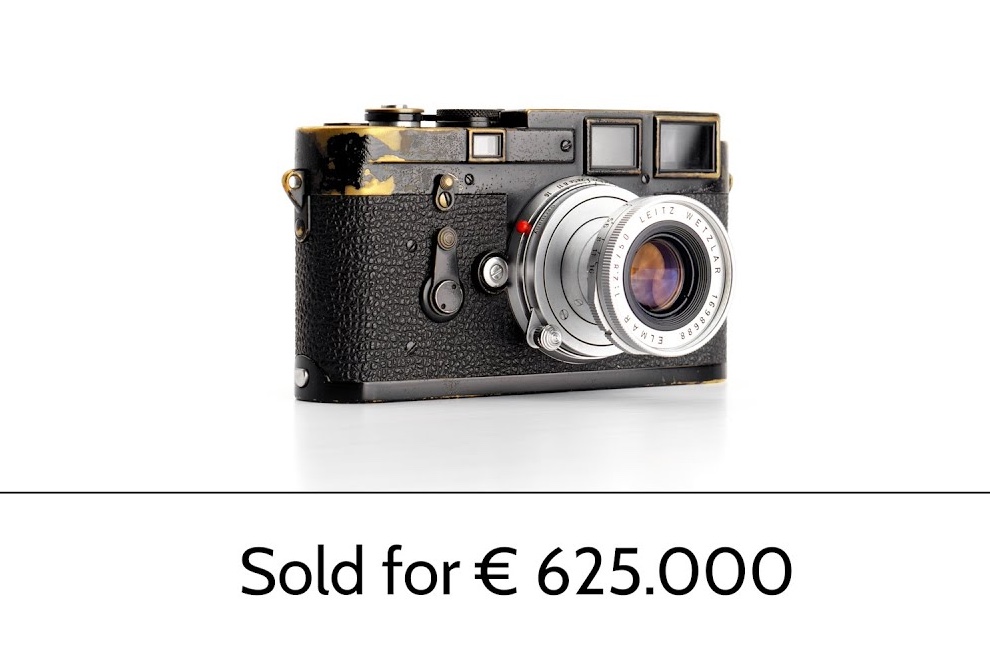
Further spectacular results were achieved for rare black paint finished Leica M cameras and lenses from the 1950s, which were produced specifically for press photographers at the time: a very rare black lacquered Leica MP sold for €425,000. Less than 140 of these cameras were produced in 1956. An extremely rare early Leica M3 in black lacquer fetched an impressive €625,000 – only eight examples of this version were produced in 1955 – the camera sold at auction was used internally at the Leitz factory at the time. An extremely rare, very early black lacquered Leitz Summilux 35 mm wide-angle lens from 1960 started at €28,000 and was finally sold for an incredible €162,500.
Lars Netopil: “Compared to the silver chrome-plated series versions of the time, the black lacquered Leica M models were only produced in small numbers. In addition, due to their frequent use, they were often not treated with care and today often show not only clear signs of wear, but have also been fitted with later components during repairs at the Leitz factory. This explains why cameras of these rare versions in their original condition sometimes fetch exceptionally high prices.”
Rare prototypes of Leica lenses were once again a particularly interesting part of this year’s auction catalogue. An extremely rare prototype of a Leica 28 mm wide-angle lens from 1954 was auctioned for an astonishing €118,750. Only two examples of this lens model, which started at €15,000, are known to exist today.
In addition to Leica, some particularly spectacular results were also achieved for collectibles from other brands. These included some very rare items produced in the former Soviet Union. For example, an extremely rare GOI Pioneer camera from 1944 was auctioned for €81,250.
‘The cameras, and in particular the Leica copies produced in the Soviet Union, were generally manufactured in very large numbers. However, certain very early models are extremely rare. These include prototype cameras and lenses. When such items come up for auction, very high prices can usually be expected,’ says Jo Geier.
The next auction by Wetzlar Camera Auctions will take place on October 10th 2026. Consignments are now being accepted. For more information, visit www.wetzlarcameraauctions.com.
The results for the latest Wetzlar Camera Auctions 7 are now available online: