Leica X1 is the first compact camera included in the recommended list for submissions to Getty Images

Update: Getty has confirmed to BJP that the Leica X1 is in fact approved for submissions to their image library.
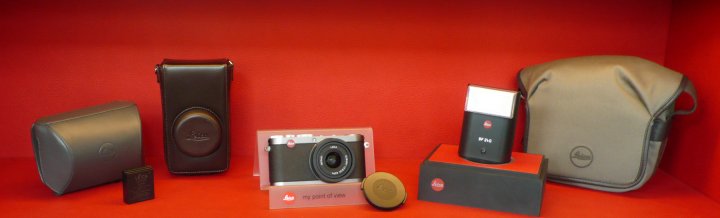
leica x1 accessories Leica X1 is the first compact camera included in the recommended list for submissions to Getty Images

Leica X1 just made the list of "recommended for submissions to Getty Images" cameras . You can see the full list here. In addition to the Leica X1, the M8, M8.2 and M9 are also included (S2 falls in the medium format category and is automatically included).

Via AP

Related posts:

  1. In addition to D-Lux 5, Leica will release another Panasonic based compact camera at Photokina
  2. Leica announces V-Lux 30 compact point and shoot camera
  3. First images from Leica X1
  4. Leica will announce new low end compact camera on May 26th
  5. Photoshop Elements 8 will be included with the Leica V-Lux-20 (plus detailed specs and more pics)

This entry was posted in Leica X1. Bookmark the permalink. Both comments and trackbacks are currently closed.

10 Comments

  1. Oliver Nevill
    Posted August 6, 2010 at 6:16 pm | Permalink

    And Getty Images just officially confirmed it:
    “”We do support and approve a number of cameras for use by our contributing photographers and the Leica X1 is the first compact camera we have given this approval to,” a spokeswoman tells BJP.”
    It’s here: http://www.bjp-online.com/british-journal-of-photography/news/1727025/getty-images-approves-compact-camera

  2. ZoetMB
    Posted August 7, 2010 at 10:52 am | Permalink

    Big deal. They also accept images from the Nikon D90 and the old D200, the Canon EOS30D, 40D and 7D.

    Seems to me they’re simply looking for a minimum sensor size and a minimum resolution, even though they don’t list all the cameras that pretty much meet the same requirements as those they do list. And since higher pixel counts can lead to more noise, their logic is flawed anyway.

    Lenses don’t even seem to be a factor for them.

    In this case, they shouldn’t even list cameras. They should list the sensor size and resolution requirement.

    • Eric
      Posted August 7, 2010 at 7:04 pm | Permalink

      I was thinking the same thing, they really need to revise their list. They recommend the Olympus E3, but not the Olympus E30, E620, E-P1, E-P2, and E-P1L even though all of them actually have a newer, better, and higher resolution sensors. Neither the Nikon D5000 or Pentax K-x are recommended even though the Canon 30D and Nikon D200 are…and as former D200 owner I can attest that the IQ on that camera pales in comparison to the K-x, or any of the newer APS-C or even 4/3′s sensors.

  3. Lainer
    Posted August 7, 2010 at 11:11 am | Permalink

    Hey, don’t ‘dis the D90. It’s nicer than a X1! LOL!!

    • Eric Pepin
      Posted August 8, 2010 at 10:35 pm | Permalink

      id put my d300s agains a X1 any day, my 85 1.4 is no doubt equal to the punny leica lens regardless of where it was made, then again my d300s is a big metal machine while the x1 is pocket sized.

      Sigma DP2 anybody ?

      • Bradley
        Posted August 12, 2010 at 11:15 pm | Permalink

        @Eric – The D300S has the exact same sensor as the X1, but the X1 has Leica glass and is a fraction of the size! So the X1 is less obtrusive, and takes a better quality image. Just went to Lollapalooza last weekend and they wouldn’t allow any interchangeable lens camera in. That day you couldn’t even get in.

        Leica owners have always known there is something about rangefinders, and the X1, that get you closer than a huge, loud, DSLR.

  4. David
    Posted August 7, 2010 at 11:42 am | Permalink

    I think the significance here is that the X1 is the smallest camera body to be on that list; that’s all. If you happen to be walking in Venice and ran into something stock worthy, and all you had on your person was the X1 because you didn’t want to carry a DSLR and didn’t want to bother with the manual focus of the M cameras, Getty is just saying you can still capture stock images up to their snuff (provided the usual photo criteria are met). All things being equal (comparing Apple to Apple), it seems there is no better digital camera than the X1 in it’s size and weight class. I say digital because quite frankly if you know what you are doing you can still out resolve many of the digital cameras out there with a compact 35mm film camera.

  5. Posted August 7, 2010 at 12:54 pm | Permalink

    Getty is also listing the Canon Rebel T2i as an approved camera.

  6. Posted August 9, 2010 at 7:03 pm | Permalink

    The cameras “approved” are the ones for editorial work which is usually submitted in a size of 3000 pixels on the longest side and delivered directly and hires to the major subscribers of news, sport and entertainment imagery.

    They don’t look at MP size alone but at image quality (I’ve submitted quite many upscaled Digilux 2 photos because the images are clean and sharp enough).

    Here is what their two reviewers wrote on the Leica M8 back when:

    1)

    “The Leica M8 shoots at 10.3Mp, which when converted from RAW produces a 29.7Mb TIFF file in 8 bit colour. It features a low noise CCD which was specifically designed for Leica and does not use an anti-alias filter which hugely improves on RAW image detail.

    We have recently tested the camera in a range of situations with very good results. The quality of the files is of a high standard, closely competing alongside SLR’s with similar Mp specifications. The files we shot captured an impressive amount of information, with excellent interpretation of fine detail. The colour response was very good, but lacked the vibrancy or punch direct from camera which is normally expected with a camera at this price range. Shadow detail was excellent, the CCD suppressing noise incredibly well in darker areas.

    The camera shoots in the RAW ‘DNG’ format which is not specific to any camera manufacturer. The files we captured were processed with Capture One Pro.

    The camera is of typical Leica quality, with a solid ‘no fuss’ design that feels like it is built to last a lifetime. The controls are simple and intuitive with the 2.5″ LCD display clear and bright. If you are a fan of Leica systems you will not be disappointed, the M8 is a lovely camera and retains the feel of quality which has long been associated with Leica. The ability to shoot such hi-resolution files on a camera so small and compact is a fantastic feat of technology. Travel photographers need never be without a camera in their bag again!!”

    ——-

    2:

    “File quality from this camera is immediately impressive. Image detail is extremely sharp the clarity is striking; colours are warm and vibrant whilst retaining a true likeness in appearance.

    When capturing fine hair detail, the camera does a good job in interpreting these areas without some of the digital ill affects that can be very noticeable. After interpolation it is possible to see some level of softening – which can easily be remedied with the application of some minimal sharpening within Photoshop.

    It is possible for images from this camera to be interpolated to all of the files sizes offered through our Large Format File Service; although at the top end of the scale (300Mb) some digital issues are becoming apparent. Having said this when viewed at print size, the images are totally acceptable even at these billboard size proportions.

    What is remarkable about this camera is the lack of noise produced in the shadow areas, even after applying a considerable density correction in Photoshop, little noise is evident.

    Excellent results from this highly desirable camera. “

  7. john
    Posted August 11, 2010 at 2:09 pm | Permalink

    The Canon G10 was the first compact to have Getty Approved Images.